Programs
our approach & methodology
AIMP Training academy
- Leadership
- Sales
- Emotional Intelligence
Topics could include but not limited to the following;
-
Faith and Work Seminars Conduct seminars exploring the relationship between faith and work, addressing ethical dilemmas and practical applications.
-
Online Courses Develop online courses on topics such as ethical leadership, social responsibility, and integrating faith into the workplace.
-
Educational Workshops Offer workshops for schools and colleges on the importance of ethics and social responsibility in business.
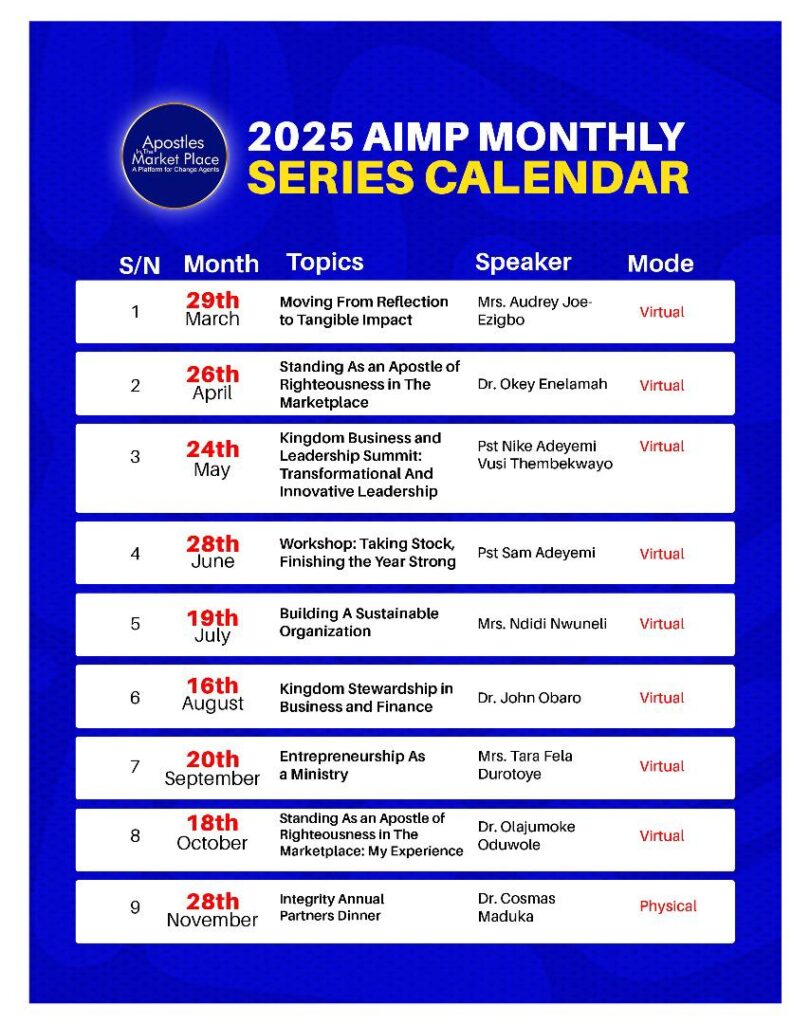

2025 AiMP Monthly Series Calendar
S/N |
Month |
Topics |
Speaker |
Mode |
|---|---|---|---|---|
|
1 |
29th March |
Moving From Reflection to Tangible Impact |
Mrs. Audrey Joe-Ezigbo |
Virtual |
|
2 |
26th April |
Standing As an Apostle of Righteousness in The Marketplace |
Dr. Okey Enelamah |
Virtual |
|
3 |
24th May |
Kingdom Business and Leadership Summit: Transformational And Innovative Leadership |
Pst Nike Adeyemi, Vusi Thembekwayo |
Virtual |
|
4 |
28th June |
Workshop: Taking Stock, Finishing the Year Strong |
Pst Sam Adeyemi |
Virtual |
|
5 |
19th July |
Building A Sustainable Organization |
Mrs. Ndidi Nwuneli |
Virtual |
|
6 |
16th August |
Kingdom Stewardship in Business and Finance |
Dr. John Obaro |
Virtual |
|
7 |
20th September |
Entrepreneurship As a Ministry |
Mrs. Tara Fela Durotoye |
Virtual |
|
8 |
18th October |
Standing As an Apostle of Righteousness in The Marketplace: My Experience |
Dr. Olajumoke Oduwole |
Virtual |
|
9 |
28th November |
Integrity Annual Partners Dinner |
Dr. Cosmas Maduka |
Physical |



Religious Programs
Spiritual Retreats
Organize retreats for business professionals to reflect on their faith and its relevance to their work.
Faith-based Counseling
Provide counseling services for individuals seeking guidance on integrating their faith into their work life.
Prayer Groups
Facilitate prayer groups for business professionals to come together and pray for each other’s work and ethical challenges.
Education Programs
Faith and Work Seminars
Conduct seminars exploring the relationship between faith and work, addressing ethical dilemmas and practical applications.
Online Courses
Develop online courses on topics such as ethical leadership, social responsibility, and integrating faith into the workplace.
Offer workshops for schools and colleges on the importance of ethics and social responsibility in business.
Enterprise Programs
Social Enterprise Incubator
Create a program to support the development of social enterprises that align with the organization’s values and mission.
Business Incubation Program
Provide support and resources for budding entrepreneurs who are committed to ethical business practices.
Microfinance Initiatives
Establish microfinance programs to provide financial support to small businesses that are making a positive social impact.
Business Programs
Corporate Social Responsibility (CSR) Partnerships
Collaborate with businesses to develop and implement CSR initiatives that align with the organization’s mission.
Ethical Business Awards
Recognize businesses that demonstrate exceptional ethical practices and social responsibility.
Business Networking Events
Host networking events for business leaders to discuss and promote ethical business practices.
Impact Assessment
Our impact assessment concept focus on evaluating the effectiveness and outcomes of our programs and initiatives in line with our mission.
Here are our Impact Assessment Concepts:


Define Objectives & Outcomes
- Clearly articulate the specific objectives and intended outcomes of each program or initiative.
- Align these objectives with the overall mission and values of Apostle.
Data Collection & Monitoring
- Implement a systematic data collection process to gather relevant information.
- Use both quantitative and qualitative data, including surveys, interviews, and focus groups, to monitor and evaluate the progress of initiatives.
Stakeholder Feedback
- Collect feedback from beneficiaries, volunteers, donors, and community members.
- Utilize surveys and interviews to capture the perspectives and experiences of those directly impacted by Apostle's activities.
Develop Key Performance Indicators (KPIs)
- Identify measurable KPIs that reflect the success of each program.
- Examples include the number of beneficiaries reached, improvements in community well-being indicators, and successful skills development outcomes.
Baseline & Comparative Analysis
- Establish baseline data before the initiation of programs to provide a reference point for measurement.
- Conduct comparative analyses over time to assess changes and improvements.
Cost-Benefit Analysis
- Evaluate the efficiency of resource utilization by conducting a cost-benefit analysis.
- Compare the financial investment in programs against the achieved outcomes and impact.
Sustainability Assessment
- Assess the sustainability of the impact created by Apostle's programs.
- Consider whether positive changes are likely to be maintained over the long term and identify factors that contribute to or hinder sustainability.
Case Studies & Success Stories
- Compile case studies and success stories to illustrate the real-world impact of AiMP's work.
- Use narratives to highlight specific instances where the organization has made a meaningful difference in individuals' lives or the community.
Regular Reporting & Communication
- Provide regular impact reports to stakeholders, including donors, volunteers, and the community.
- Use these reports as a tool for transparency, accountability, and communication of achievements and challenges.
Continuous Improvement
- Use the findings from the impact assessment to inform strategic decisions and refine programmatic approaches.
- Foster a culture of continuous improvement within the organization based on lessons learned from the assessment.
Impact Assessment Strategies
Refine Program Objectives & Outcomes
- Regularly review and refine the objectives of each program to ensure they remain relevant and aligned with the organization's mission and community needs.
- Adapt program outcomes based on lessons learned and emerging challenges.
Enhance Monitoring & Evaluation Systems
- Invest in advanced data collection tools and technologies to streamline the monitoring and evaluation process.
- Implement real-time tracking systems to promptly identify any deviations from the expected outcomes.
Continuous KPI Review & Adjustment
- Periodically reassess and adjust key performance indicators (KPIs) to reflect the evolving nature of programs and community dynamics.
- Ensure that KPIs align with the organization's strategic goals and priorities.
Strengthen Stakeholder Engagement
- Establish regular feedback mechanisms with beneficiaries, volunteers, donors, and community members to enhance communication.
- Actively seek input from stakeholders to understand their perspectives and incorporate their feedback into decision-making processes.
Optimize Resource Allocation
- Conduct regular cost-benefit analyses to identify areas where resources can be optimized for maximum impact.
- Explore cost-effective alternatives without compromising the quality and effectiveness of programs.
Promote Sustainability Strategies
- Develop and implement strategies that contribute to the sustainability of program impacts, such as skill-building initiatives for community members.
- Explore partnerships and collaborations that can provide ongoing support beyond the initial intervention.
Integrate Continuous Improvement Practices
- Institutionalize a process of continuous improvement, where regular reviews and assessments inform strategic planning and decision-making.
- Encourage staff and volunteers to contribute ideas for improvement and innovation.
Adopt Adaptive Management Practices
- Embrace an adaptive management approach, allowing for flexibility in program implementation based on ongoing assessments and changing circumstances.
- Encourage a culture of learning from both successes and failures to inform future decisions.
Highlight Success Stories and Case Studies
- Actively share success stories and case studies through various communication channels to showcase the tangible impact of Apostle's work.
- Use these narratives to inspire and engage stakeholders, attracting support and participation.
Foster a Culture of Learning
- Establish a learning culture within the organization that encourages reflection, knowledge sharing, and professional development.
- Provide opportunities for staff and volunteers to participate in training programs and workshops to enhance their skills in impact assessment.